Skip to main content
Healthcare Guide
If you’re setting up healthcare in Spain, getting your Tarjeta Sanitaria in Spain is the step that actually unlocks the system — it’s the card that lets you see a doctor, fill a prescription, or walk into a hospital without paying at the counter. But it isn’t something you can just walk in and request: it’s tied to your healthcare entitlement, and the exact process depends on which autonomous community you live in. This guide walks through what the card actually is, who qualifies, what you’ll need, and how to apply — plus what changes if you move regions or lose the card along the way.
⭐ Complete Guide | ⚖️ Official Sources | 🤝 Interpreter Insight | 🤖 AI + Real Experience | 💡 Expert Tips | ⚠️ Common Mistakes | 📋 Checklist | ❓ FAQs Included | 🕒 Recently Updated | ⏱️ Step-by-Step Guide | ⬇️ Downloads
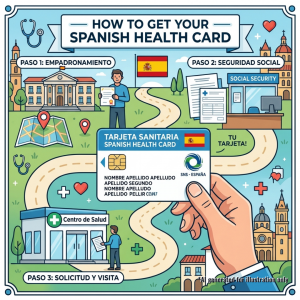
What Is a Tarjeta Sanitaria in Spain?
The Tarjeta Sanitaria Individual (TSI) — usually just called the Tarjeta Sanitaria, or health card — is the official document that identifies you within Spain’s National Health System (Sistema Nacional de Salud, or SNS). It’s not simply a general identity card: it’s specifically tied to your entitlement to public healthcare, and you can’t get one without first establishing that entitlement.
Once issued, the TSI is what you present — physically or, increasingly, digitally — to be identified at a Centro de Salud (health centre), to see your assigned doctor, and to have prescriptions filled at any pharmacy in Spain. The Spanish Ministry of Health describes it as the document that’s both necessary and sufficient to identify you when accessing SNS services and benefits — meaning once you have it, you generally don’t need to bring anything else to prove your right to care.

Who Can Get a Tarjeta Sanitaria in Spain?
Eligibility comes before the card — the TSI is proof of an entitlement you already have, not something that creates that entitlement on its own. Broadly, people who can apply include:
- Employees registered with Social Security
- Self-employed workers (autónomos)
- Pensioners, including EU/EEA pensioners using an S1 form
- Dependants of someone already entitled to public healthcare
- Anyone else with a recognised, accredited right to public healthcare — including foreign residents whose entitlement has been formally established
Important: having an NIE, being registered on the Padrón, or simply living in Spain does not by itself entitle you to public healthcare. Entitlement typically comes through Social Security registration, employment, or a specific route recognised by your regional health service — the TSI application only comes after that’s in place.
What Do You Need Before Applying?
A few different pieces need to be in place before you can apply for your Tarjeta Sanitaria, and it’s easy to confuse them since they’re often mentioned in the same breath:
- NIE ≠ healthcare entitlement. Your NIE (Número de Identificación de Extranjero) identifies you administratively as a foreign national — it doesn’t, by itself, grant access to public healthcare.
- Padrón ≠ Tarjeta Sanitaria. Registering on the Padrón confirms where you live. It’s often required as supporting documentation, but it isn’t the same as being registered for healthcare.
- Social Security registration ≠ the physical health card itself. Being registered with Social Security is usually how your healthcare entitlement gets established — but the TSI is a separate, later step, not an automatic byproduct.
Each of these plays a role in the process, but none of them substitutes for the others. Think of them as separate pieces that, together, build toward your entitlement being recognised — at which point you can actually apply for the card.

How to Apply for a Tarjeta Sanitaria in Spain
The exact procedure varies between autonomous communities, but the overall shape is fairly consistent:
- Confirm you have entitlement to public healthcare — through employment, Social Security registration, or another recognised route.
- Identify your relevant regional health authority (Servicio de Salud) — the body responsible for your autonomous community, or INGESA if you’re in Ceuta or Melilla.
- Find your local Centro de Salud or the designated application point for your area.
- Prepare the required documentation (covered in detail below).
- Submit your application, either in person, online, or through your region’s health portal, depending on what’s available locally.
- Receive your health card details or physical card, following your region’s own timeline and process.
- Register with, or confirm, your assigned primary care doctor where this is required as part of the process.
Because each region runs this slightly differently, it’s worth checking your Servicio de Salud’s own website before you start, so you know exactly which office or portal to use.

Where Do You Apply for a Tarjeta Sanitaria?
Healthcare administration in Spain is decentralised, so where you apply depends entirely on where you live:
- Your Comunidad Autónoma’s health service handles applications for its residents
- Your local Centro de Salud is often the physical point of application
- Many regions also offer online portals for parts of the process
- Some regions have dedicated health apps covering applications, appointments, and digital cards
- Ceuta and Melilla are handled separately, through INGESA (Instituto Nacional de Gestión Sanitaria) rather than a regional health service
Rather than trying to list every regional procedure here — Spain’s National Health System is genuinely decentralised, with each autonomous community running its own health service — the most reliable approach is to go directly to the Ministry of Health’s directory of regional health services and find the one for where you live.

What Documents Do You Need?
Requirements vary by autonomous community and by individual circumstances, so treat this as a typical starting list rather than a universal checklist:
- Passport or DNI
- NIE or TIE, where applicable
- Padrón documentation (proof of address registration)
- Social Security information
- Proof of your healthcare entitlement
- Documentation for any dependants being added
- Any existing healthcare documentation you already hold
Before you go, it’s worth calling or checking your regional health service’s website to confirm exactly what they’ll ask for — requirements can differ enough between regions, and even between offices, that it’s worth the extra five minutes.

Is the Tarjeta Sanitaria the Same Throughout Spain?
Not exactly — and this trips a lot of people up. Each autonomous community manages its own health card system and assigns its own regional identification code, so your TSI is, in a sense, a regional document as much as a national one.
That said, the SNS provides interoperability between regions, meaning your card is still designed to be recognised and usable across Spain. What changes is the administration behind it: don’t assume that moving to a different autonomous community means simply continuing with your existing local registration unchanged. If you move permanently, you’ll typically need to update your registration with your new region’s health service, even though the underlying card format and rights carry over.
Can You Use Your Tarjeta Sanitaria in Another Part of Spain?
This depends on what you mean by “using” it. There’s a real difference between:
- Being temporarily in another part of Spain (on holiday, travelling for work)
- Moving permanently to a different autonomous community
- Receiving planned, non-urgent care somewhere other than where you’re registered
- Needing urgent or emergency care while away from home
For identification and access to healthcare services, the TSI is valid throughout the SNS, thanks to interoperability between regional systems. Urgent and emergency care work this way in practice almost everywhere. Planned or routine care in a different region is a different matter, though, and isn’t necessarily available in exactly the same way as it would be where you’re registered — so don’t assume every service works identically in every region.
What Can You Use Your Tarjeta Sanitaria For?
Once you have it, your TSI comes into play for:
- Booking and attending GP appointments
- Being identified at your Centro de Salud
- Accessing specialist care within the public system, usually via referral
- Getting prescriptions issued and filled
- Being identified at any pharmacy in Spain
- Other SNS services tied to your registration
It’s worth being clear about what the card actually does: it identifies you. It doesn’t, on its own, determine which specific healthcare services you’re entitled to receive — that’s governed by your underlying entitlement, not the card itself.

Digital Tarjeta Sanitaria
Spain has been moving toward digital versions of the health card. A 2024 royal decree updated the rules to allow the TSI to be issued in physical format, virtual format, or both — with autonomous communities given roughly 18 months to adapt their systems.
By now, most regions have rolled out their own virtual card: Andalusia’s went live in March 2026 through its Salud Andalucía app, and Galicia launched its version around the same time through Sergas Móbil, to name two examples. Madrid has run a virtual card option for years, well before the wider rule change, and it’s now used by tens of millions of people there. Where available, the virtual card is designed to be just as valid as the physical one for identification and access to care.
Exactly which app you’ll use, and how you sign up, differs by region — so check your own Servicio de Salud for what’s currently available and how to activate it.

What If You Lose Your Tarjeta Sanitaria?
If your card goes missing, the general approach is:
- Contact your regional health service to report it
- Request a replacement through the process they specify
- Check whether a temporary or digital alternative is available in the meantime, since many regions now offer a virtual card you could switch to
- Update any personal details that may have changed, while you’re already in touch with them
Exact fees and turnaround times vary by region, so rather than guessing, it’s best to check directly with your local health service for the current process.
What If You Move House or Change Autonomous Community?
Keeping your details current matters more than it might seem, since your healthcare registration is tied to where you live:
- If you move within the same municipality or region, update your address so your records and assigned Centro de Salud stay accurate
- If you move to a new municipality, you’ll likely need a new Centro de Salud assignment
- If you move to a different autonomous community, you’ll generally need to update your healthcare registration with your new region’s health service, not just your address
Letting this lag can cause friction later — from being assigned to a health centre that’s no longer convenient, to complications if your details don’t match when you need care.
Common Tarjeta Sanitaria Mistakes
- Assuming an NIE automatically provides healthcare access. It doesn’t — entitlement is a separate step.
- Confusing the Padrón with healthcare registration. They serve different purposes.
- Applying before healthcare entitlement is actually established. The card follows entitlement, not the other way round.
- Assuming every autonomous community follows an identical process. They don’t.
- Not updating details after moving house or region. This can cause real friction later.
- Assuming a private health insurance card works the same way as the TSI. They’re not interchangeable.
- Treating the card itself as proof of every kind of healthcare entitlement. It identifies you — it doesn’t define your coverage.
Quick Comparison
| Document | What it does |
|---|---|
| NIE | Identifies a foreign national for administrative purposes |
| Padrón | Records where you’re registered as living |
| Social Security Number | Identifies you within the Social Security system |
| Tarjeta Sanitaria | Identifies you as a user of Spain’s public healthcare system |
| Private Health Insurance Card | Identifies you with your private insurer |
These documents serve different purposes and none of them substitutes for another.

Conclusion
Getting your Tarjeta Sanitaria in Spain really comes down to five things: establish your healthcare entitlement first, apply through your region’s health service, keep your address and personal details updated, use the card whenever you access public healthcare or a pharmacy, and check your autonomous community’s current procedure rather than assuming it matches what worked somewhere else.
For the bigger picture on how Spain’s healthcare system fits together, see our guide to how healthcare works in Spain, and for the step after this one, our guide to registering with a GP in Spain.
Frequently Asked Questions
What is a Tarjeta Sanitaria in Spain?
It’s Spain’s official health card — the Tarjeta Sanitaria Individual (TSI) — that identifies you within the National Health System (SNS) once your healthcare entitlement has been established. It’s what you present to see a doctor, access specialist care, or get prescriptions filled.
How do I get a Tarjeta Sanitaria in Spain?
Confirm your healthcare entitlement, find your regional health authority, locate your local Centro de Salud or application point, prepare your documents, and submit your application through the process your region uses.
Who is entitled to a Spanish health card?
People registered with Social Security through employment or self-employment, pensioners, dependants of someone already entitled, and other residents with an accredited right to public healthcare. Having an NIE or being on the Padrón alone doesn’t qualify you.
What documents do I need to get a Tarjeta Sanitaria?
Typically your passport or DNI, NIE/TIE where applicable, Padrón documentation, Social Security information, and proof of entitlement — though exact requirements vary by autonomous community, so confirm with your regional health service first.
Where do I apply for a Tarjeta Sanitaria?
Through your Comunidad Autónoma’s health service, usually via your local Centro de Salud, an online portal, or a regional health app — or through INGESA if you’re in Ceuta or Melilla.
Is the Tarjeta Sanitaria free?
Yes — there’s no charge for the card itself once your healthcare entitlement is established. What can cost money is establishing that entitlement in the first place, depending on your situation, such as through the Convenio Especial if you don’t qualify another way.
Can foreigners get a Tarjeta Sanitaria in Spain?
Yes, once they have an accredited right to public healthcare — through employment, self-employment, Social Security registration, or another recognised route. The card follows from that entitlement rather than from residency or nationality alone.
Can I use my Tarjeta Sanitaria anywhere in Spain?
For identification and access to healthcare, yes — the SNS provides interoperability between regions. Urgent and emergency care work this way almost everywhere; planned, non-urgent care in a different region can work differently, so don’t assume every service is available identically wherever you are.
What happens if I lose my Spanish health card?
Contact your regional health service to report it and request a replacement. Some regions also let you switch to a digital version in the meantime. Fees and timelines vary by region, so check directly with your local health service.
Can I have a digital Tarjeta Sanitaria?
In most regions, yes. A 2024 royal decree allows the TSI to be issued physically, virtually, or both, and most autonomous communities have now rolled out their own virtual card. Availability and the specific app differ by region.
Is the Tarjeta Sanitaria the same in every region of Spain?
Not exactly. Each autonomous community manages its own card system and issues its own regional code, though the SNS keeps them interoperable. Moving regions permanently usually means updating your registration with your new region’s health service.
Written with AI assistance, edited and fact-checked by our team.
Official sources: Tarjeta Sanitaria Individual — Ministerio de Sanidad · Sistema Nacional de Salud · Regional Health Services Directory